Easy STEM Activities for Kids to Do at Home
Kids learn best when they are doing something with their hands. A worksheet about density stays abstract. A jar of oil and water sitting on the kitchen counter becomes a lesson they remember for years. Home-based STEM activities cost almost nothing, require no special equipment, and fit into a Tuesday afternoon between lunch and dinner. I’ve rounded up the best ones I know, organized by age and subject, so you can pick something and start today.
Why Home STEM Works Better Than You Think
Parents often assume STEM education belongs in a classroom with specialized tools. That assumption sells home learning short. The kitchen alone is a chemistry lab. The backyard is an ecology field site. A cardboard box is a structural engineering problem waiting to happen.
The research backs this up. Kids who experiment at home develop stronger problem-solving habits because they own the process. There is no teacher to bail them out. They form a hypothesis, test it, and deal with the result. That cycle is the core of scientific thinking, and it happens naturally when a kid is genuinely curious about something in front of them.
Activities by Age Group
Ages 4 to 7: Sensory and Observation-Based Science
Young children learn through touch, sight, and repetition. Keep activities short, messy, and repeatable.
Color Mixing with Ice Fill an ice cube tray with water and a drop of food coloring in each section, using red, yellow, and blue. Once frozen, let your child melt pairs of cubes together in a white bowl and watch secondary colors appear. This takes about ten minutes of active engagement and teaches color theory through direct experience.
Sink or Float Collect ten household objects, a mixing bowl of water, and a notebook. Ask your child to predict whether each object sinks or floats before testing it. Record results. A wooden spoon, a coin, a grape, a plastic lid, a marble. The point is the prediction, because that is the hypothesis habit forming early.
Ages 8 to 11: Experiments with Variables
Kids in this range can follow multi-step instructions and start to understand cause and effect in a more structured way.
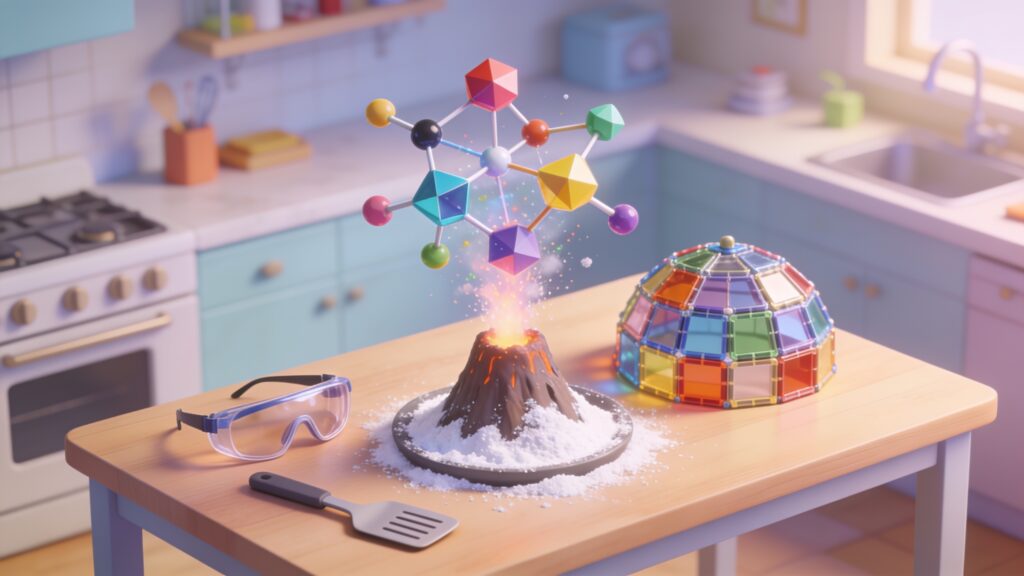
Baking Soda and Vinegar Volcano (with a twist) Every kid has done the basic version. Go further. Set up four small cups with different amounts of baking soda: 1 teaspoon, 2 teaspoons, 3 teaspoons, and 4 teaspoons. Add the same amount of vinegar to each. Measure how high the foam rises using a ruler. Now you have a proper variable-controlled experiment instead of a one-time spectacle.
Paper Bridge Engineering Give your child three sheets of printer paper, a ruler, and a handful of coins. The goal is to build a bridge between two stacks of books that holds as many coins as possible. Flat paper fails immediately, which teaches kids to think about folding, corrugation, and structural form. Most kids discover the accordion fold on their own within five minutes of failure.
Homemade Compass Magnetize a sewing needle by stroking it with a fridge magnet 30 times in one direction. Rest it on a small piece of foam floating in a bowl of water. It aligns with magnetic north. Then test whether stroke count affects accuracy. Clean, concrete, and connected to real navigation history.
Ages 12 and Up: Data-Driven Projects
Older kids can handle longer projects that span several days and produce measurable data.
Plant Growth Under Different Light Germinate bean seeds in identical cups of soil. Place them under different light conditions: full sunlight, a north-facing window, a lamp with a grow bulb, and a dark cupboard. Measure stem height daily for two weeks. Graph the results. This teaches data collection, graphing, and photosynthesis in one project that costs about $3.
DIY Water Filter Layer a plastic bottle with gravel, sand, and activated charcoal from a pet store. Pour muddy water through and compare input versus output clarity. Then test whether layer order changes the result. This connects directly to environmental engineering and real-world water treatment.
Quick Reference: Materials and Difficulty
| Activity | Age Range | Main Materials | Time Required |
|---|---|---|---|
| Color Mixing Ice | 4 to 7 | Ice tray, food coloring | 20 minutes |
| Sink or Float | 4 to 7 | Bowl, household objects | 15 minutes |
| Volcano with Variables | 8 to 11 | Baking soda, vinegar, cups | 30 minutes |
| Paper Bridge | 8 to 11 | Paper, coins, books | 45 minutes |
| Homemade Compass | 8 to 11 | Needle, magnet, foam, bowl | 20 minutes |
| Plant Growth Study | 12 and up | Seeds, soil, cups, lamp | 2 weeks |
| DIY Water Filter | 12 and up | Plastic bottle, gravel, sand | 1 hour |
Tips That Make Any Activity Work Better
A few habits separate a STEM activity that sticks from one that gets abandoned after five minutes.
- Write it down. A simple notebook where kids record their prediction, their method, and their result builds the scientific thinking habit faster than any single experiment.
- Let things fail. A bridge that collapses is more educational than one that holds. Ask “why did it fail?” before helping fix it.
- Ask before telling. If your child is stuck, ask “what do you think is happening?” before explaining. The struggle to articulate is where learning consolidates.
- Repeat with one change. Run the same experiment twice with one variable altered. This is how kids start to understand controlled testing.
- Connect it to something real. Tell your child that engineers test bridges the same way, or that water treatment plants use the same layering principle. Context makes the activity meaningful.
Key Takeaways
Home STEM activities work because they are low-stakes, hands-on, and repeatable. Start with whatever you have in your kitchen or backyard. Focus on the process of prediction and testing, not on getting the right answer. Young kids need sensory, short-format activities. Older kids benefit from projects that span multiple days and produce data they can analyze.
Pick one activity from this list, gather the materials today, and run it with your child this week. The habit of asking “what will happen if I try this?” is worth more than any single correct answer.